

March 1, 2026
As Japan hurtled toward modernity, one writer insisted that the nation’s future rested not just on factories or warships, but on what its people ate.
In the mid-1920s, Japan’s modern experiment with democracy and cosmopolitanism was in full flow. Cities like Tokyo and Osaka were growing rapidly, and their streets were abuzz with people out shopping or heading to work, strolling along past noisy trams and brightly-lit windows. Music, literature and film from all over the world was on offer, and communication was faster than ever thanks to the telegraph and the radio. Women were joining the workforce in ever-larger numbers: as factory and office workers, nurses and maids, cooks and café waitresses.
Japan was moving forward at breakneck pace. But one man seemed to be going in the other direction. Murai Gensai was in his sixties and was known as a local eccentric in Hiratsuka, just south-west of Tokyo. He had exchanged his job for home farming and periodic attempts at pit-dwelling in the mountains. He had tried intermittent fasting and dining only on raw, unprocessed foods – including, it is claimed, live insects.
Had Murai lost his mind? Was he living out a radical rejection of “modern” Japan? The answer seems to be that he was seeing through to its logical conclusion an idea that had governed large parts of his life: food is the foundation of both physical and moral health. You really are what you eat.
Murai had been born into a time when Japan believed itself to be up against the world: locked in an all-or-nothing struggle to survive, modernize, and defend its borders before Western rivals could take advantage of its weakness. Strength and resilience were sought out in every area of life, including people’s diets and health habits. Murai, perhaps more than anyone else in his era, had studied what people put on their plates – East and West alike – and what it meant for them, and for their societies. He believed both in the nutritional value of food, and in taking sophisticated pleasure from it.
Murai conveyed all this so vividly in his literary writing that his great book on food, Shokudōraku (The Gourmet’s Way) – part novel, part food guide – became a runaway bestseller. He foreshadowed many of the trends of our own times, from Eatlit – sensual literature focused on the enjoyment of food – to the ‘food porn’ and cooking tips offered by an endless roster of social media influencers. At the same time, Murai and his writing about food take us to the heart of the great tensions of his time in Japan: individual fulfilment vs. the needs of wider society, a ‘Japanese’ way of life vs. the creeping Westernisation of Asia, eating for pleasure vs. eating for personal and national survival.
Murai Gensai was born in Mikawa-Yoshida Domain (present-day Aichi Prefecture) in 1864, to a samurai family associated with great learning. Both his father and grandfather served their domains as Confucian scholars. By the time Murai was born, that world was already passing away. Japan was undergoing powerful political convulsions, set off by the visit, a decade earlier, of the American Commodore Matthew C. Perry. He and his heavily-armed warships had arrived off Japan’s shores with a letter from the US President, demanding friendly relations – at the point of a gun.
Should Japan accept friends like these? Should it – could it – resist? The failure of the Shogunate in Edo and the Imperial Court in Kyoto to agree on an appropriate response launched Japan into a decade and more of the most serious political instability it had seen for more than two centuries. While Murai was still a toddler, that instability spilled over into civil war.
The shogunate, which had controlled Japan since the turn of the seventeenth century, was brought down. In its place, a small group of young, middle-ranking samurai took charge. They adopted the young emperor as their figurehead and set about transforming the country: retaining what they could of its cultural traditions, while embracing Western learning in everything from politics and the law to science, medicine, and the arts.
Murai’s father was clever enough to sense which way the wind was blowing. He moved the family to Edo, renamed Tokyo (‘Eastern Capital’) by the country’s young leaders, so that Murai could receive the sort of education that would equip him to succeed in the new Japan. Confucian learning had served the samurai well for centuries. But now that the vast gulf between Western and Japanese technological achievement had been laid bare, a backlash had begun against forms of learning that were insufficiently practical. Confucianism, and to a lesser extent Buddhism, stood accused of wasting people’s time and energies. Japan’s best-known intellectual of the era, Fukuzawa Yukichi, denounced scholars like Murai’s father as mere “rice-consuming dictionaries.”
Murai’s education focused heavily, as did that of many ambitious young boys of the time, on foreign languages. His father enrolled him at the Tokyo School of Foreign Languages in 1873, where he studied Russian with such ferocity that he had to withdraw a few years later, after succumbing to nervous disorders. Managing to establish himself as a journalist and a novelist nonetheless, Murai went on to channel his firsthand experience of the frailties of mind and body into his writing.
As a literary theme, these concerns were a perfect fit for the late Meiji (1868 – 1912) and early Taishō (1912 – 1926) eras. Japan’s political and intellectual class was deeply concerned, in the latter part of the nineteenth century, with how the country might quickly modernize, and thus secure itself in what was clearly a dangerous world. This was the “high noon” of modern Western imperialism, whose impact on China – long regarded as a kind of cultural big brother to Japan – was especially shocking.
Obvious and urgent measures included developing Japan’s economy, and ensuring that it possessed the industrial base to manufacture the weapons and warships required to guarantee its security. Beyond that, people speculated about the source of the Western world’s advances in science and technology. What drove and empowered westerners in projecting their power and culture around the world?
Some Japanese commentators answered that question by focusing on Western democratic and civil institutions. Others looked for explanations to language and religion. But food and nutrition, too, were recognised as highly significant. Many of the Westerners encountered in treaty ports like Yokohama, or on visits abroad, were taller, broader, and physically stronger than their Japanese counterparts. Given that security in the modern world rested on productivity – including strenuous factory labour – and on battlefield prowess, how could Japan make up for this disadvantage? One of the solutions was to investigate Western diets, and to see how the Japanese diet might need to change.
Those investigations quickly resulted in political decisions to encourage the consumption of more dairy products, and to re-adopt meat-eating, after long centuries during which Buddhist taboos against killing animals had kept it mostly off the menu. Japan’s modern armed forces were served beef to help them recover from injuries and to build up their bodies. The Emperor followed suit, prompting an attempt by angry Buddhist monks to break into the Imperial Palace and remonstrate with him.
Next came the populations of cities like Tokyo, where new “stew-houses” developed magical combinations of beef, onions, miso and soy sauce. As the number of cows slaughtered in Japan trebled between 1882 and 1887, the Japanese diet was on its way to becoming the envy of the world: it eventually combined a mastery – developed during nearly 1200 years of the Buddhist ban on meat – of tofu, fish, vegetables, and fermented ingredients like miso, with high-quality beef and pork.
Tasty though those stew-house creations must have been, the underlying ethic of the Meiji era was austerity and self-sacrifice in service of the nation. Writers like Murai, who suffered from nervous disorders – including what would now be regarded as depression – used to claim that their conditions had been brought on by the stresses and strains of modern living: heavy workloads, charitable initiatives, participation in the burgeoning civic life of the nation. Such suffering was, to an extent, a badge of honour. Some of the period’s great novelists, including Natsume Sōseki, pioneered forms of literature, including the ‘I-novel,’ at whose heart lay unsparing reflections on the burdens of living through a period of weighty responsibilities and rapid change.
One would expect anyone writing about food in this era to focus on its basic function: supplying energy and nutrition to a population with much to do. Murai Gensai went far beyond this, becoming a bridge between Meiji-era austerity and the more cosmopolitan and indulgent Taishō period. By the turn of the twentieth century, he was already known as a novelist with an interest in politics and science fiction. But what really made his reputation was a series of novels, serialised in the newspaper he worked for, the Yūbin Hōchi Shimbun, about various ‘pathways to pleasure’ – dōraku, in Japanese.
Had Murai been writing in the late Edo era (1600 – 1868), a series of books on this theme might well have been sensual, ribald, or frivolous in nature. But Murai was a Meiji man, through and through. The intent of his novels, which covered topics including sake, women and fishing, was to reform people’s thinking. Onna-dōraku (Womanly Pleasures) argued against men visiting geisha or keeping mistresses. Sake-dōraku was a condemnation of alcohol abuse.
By far the most famous book in the series – which was intended to run to one hundred novels, but never got beyond a handful – was Shokudōraku (1903), usually translated as Gourmandism. First published in serialised form, and then as a set of four volumes – ‘Spring,’ ‘Summer,’ ‘Autumn,’ and ‘Winter’ – it became a bestseller and one of the most widely-read novels of the Meiji period. A theatre adaptation was produced, featuring an invitation for audience members to try out food being cooked on stage.
The book tells the story of an accomplished young woman named Otowa and her brother, Nakagawa. The two of them are sufficiently well versed in the culinary arts to provide catering services and cooking classes to their high society friends. Murai brings out Otowa’s sophistication by setting her alongside another young woman, Odai, who is depicted as an ugly, overweight rube, utterly uncivilised.
Much of the drama revolves around Nakagawa’s friend, Ōhara. He is under family pressure to marry Odai, who is his cousin, after her father helped to pay for Ōhara’s education at Tokyo Imperial University. He would rather marry Otowa, less for her beauty than because of what he hears about her skills in the kitchen. The clue is in his name. ‘Ōhara’ means ‘big field,’ and it was a common surname in this era. But readers of Murai’s book would immediately have recognised the pun: the same word, with different kanji, can mean ‘big stomach.’ And indeed, Ōhara is a very large man, blessed – or cursed – with a stupendous appetite.
Romantic drama aside, the erudite Nakagawa serves as a mouthpiece for Murai. His message is straightforward: in food, as in everything else, Japan must draw from the very best of what the world has to offer. Such is the way to civilisation and national strength: avoiding, on the one hand, a narrow nationalism, and on the other, an uncritical embrace of the foreign. Shokudōraku, it should be noted, was published at a time when Japan was riding high in the world. It had vanquished China in war (1894-5), and entered into a prestigious alliance with Great Britain (1902).
Had Shokudōraku been nothing more than a piece of didactic, modern fiction about the backwardness of arranged marriages and Japan’s need to seek out wisdom around the world, it would surely not have sold anything close to its 100,000 copies. The book’s claim to fame – and to striking originality – lies in its inclusion of no fewer than 630 recipes, drawn from Japanese, Chinese, and Western cuisine. Murai is thought to have owed much here to his wife, Takako, who worked as a food researcher and on whom the book’s heroine – Otowa – may loosely have been based. Murai relied, too, on his own experiences of living in America, and on advice from top chefs, doctors and nutritionists in Japan. The result is a cast of characters in Shokudōraku who are able to talk extensively about everything from the quality of ingredients to methods of preparation.
Amongst the delights found in the pages of Shokudōraku are oyster rice, curry, waffles, macaroni-style udon noodles in white sauce and omelette-rice. A little harder to stomach, perhaps, was beef brain miso. The preparation and nutritional rationale for each is worked by Murai into casual conversation between his protagonists, alongside the importance of a clean and well-equipped kitchen. Hygiene had become an enormous concern by this time in Japan. While nutrition built up the body, germs and disease always threatened to bring it down again.
Japan was never an especially dirty place. While no stranger to smallpox, the city of Edo had managed to support the largest urban population in the world without disease outbreaks such as typhus as frequent or sustained as those seen in cities like London or Paris. This was partly down to an efficient system for collecting human waste, and then carting it out of the city to fertilise fields. There was an equally efficient system for bringing clean water in, via aqueducts made from stone and wood, and then using it in a specified order: first for drinking and cooking, and then for bathing and cleaning.
Still, in everything from medicine and midwifery to the building of new neighbourhoods and homes, the leaders of Meiji Japan regarded cleanliness as essential, both to human health and to the civilised reputation they sought to cultivate beyond Japan’s borders. It was not uncommon, in this era, for magazines to publish feature pieces about the cleanliness and general good order of the homes of noble and notable people.
Shokudōraku picked up on this trend. The Spring volume featured a frontispiece illustration (kuchi-e) of a spacious kitchen in the home of Ōkuma Shigenobu, a senior member of Japan’s ruling oligarchy and a relative of Murai’s wife, Takako. Painted by Yamamoto Shōkoku, it shows the fusion of Japanese with Western styles that Murai was advocating. The individual meal trays and small dishes would have been instantly recognisable to people from an earlier era. But these were joined by Western-style raised work surfaces, separate areas for food preparation, a wall clock, and an early example of a gas-fired stove. Much as social media influencers more than a century later would offer viewers a virtual tour around an exemplary prep space, here was Murai showing his readers how cooking in the twentieth century ought to be done.
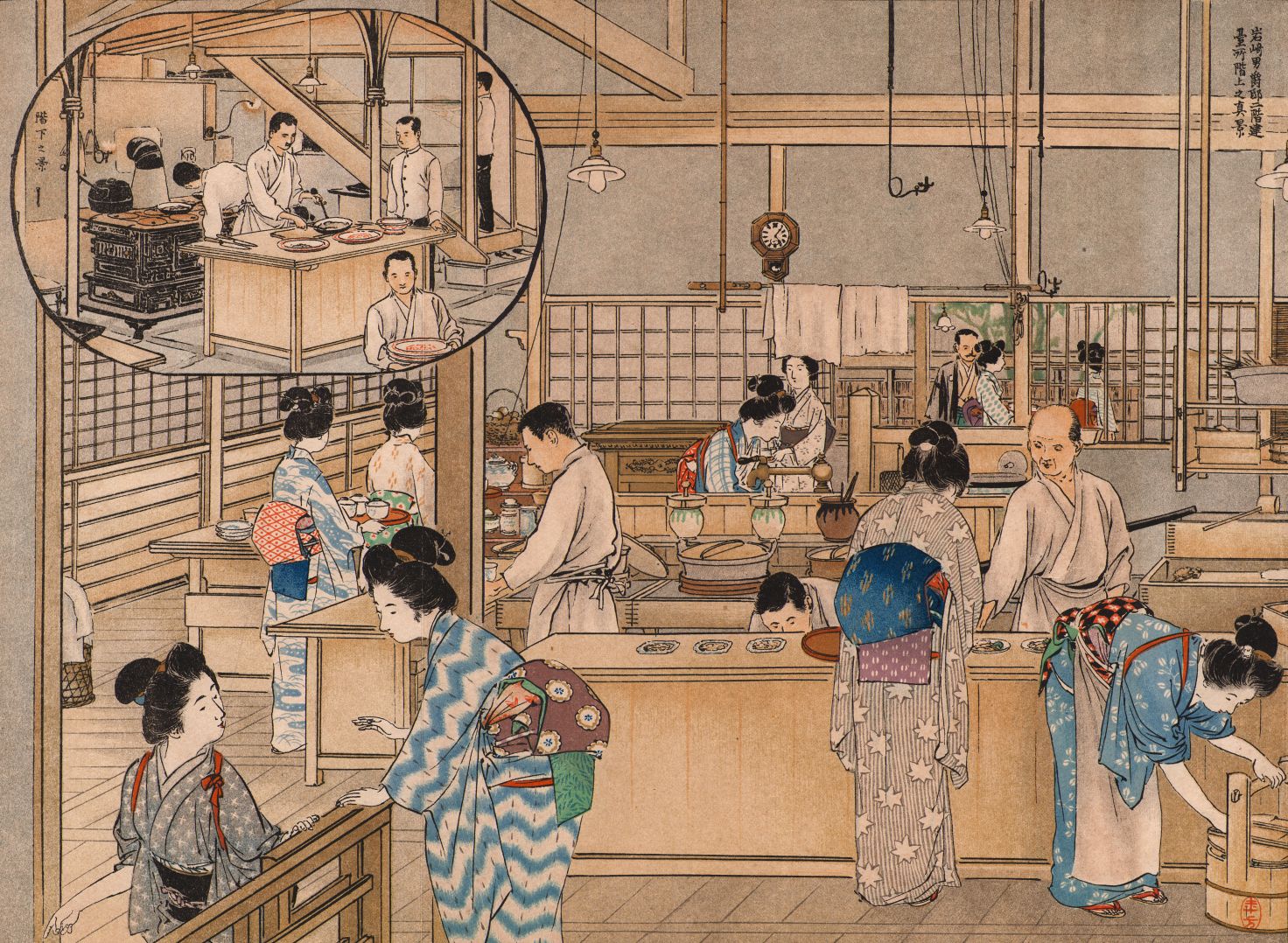
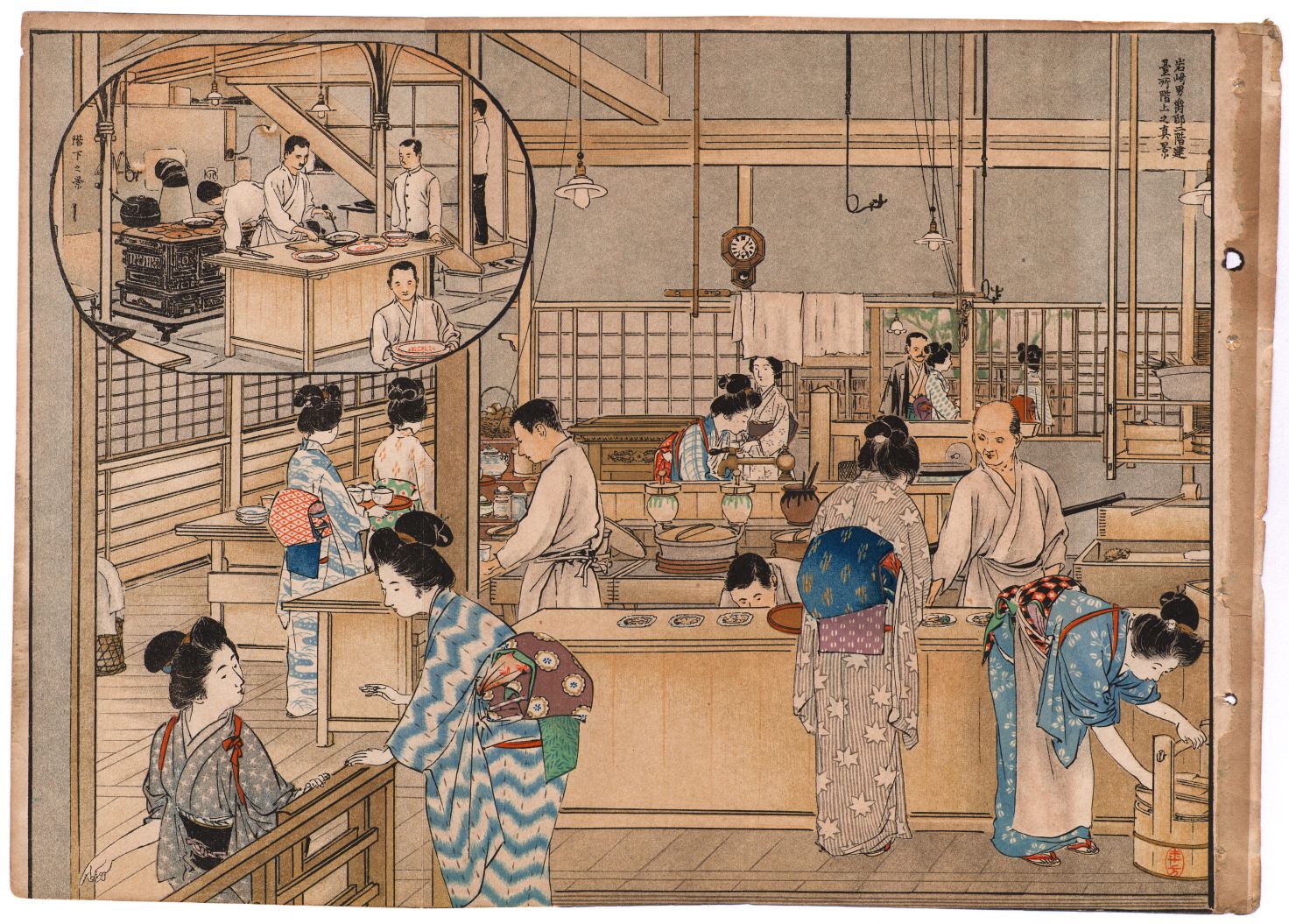
The Summer volume of Shokudōraku carried an illustration of the kitchen at the home of Baron Iwasaki, who was also distantly related to Takako. It was similarly modern in style and facilities, but this time spread across two storeys. The upper floor was used for preparing Japanese cuisine; the lower floor, for Western cuisine. The illustration was by Mizuno Toshikata, who apprenticed with Tsukioka Yoshitoshi: widely acknowledged as the last great master of the ukiyo-e print. Toshikata captured both floors in his picture: the Japanese kitchen takes up most of the image, while the Western kitchen – complete with a gas-powered range – is shown in a small bubble in the top-left.
Murai’s desire to set his fellow Japanese on the right path in terms of nutrition and eating habits opened him up to a certain amount of criticism. A writer called Kōda Rohan penned a comic-satirical response to Murai, lampooning his seriousness by imagining a competition amongst a group of people to try out “true delicacies.” These included steamed toads and python wine, alongside live, honey-fed baby mice.
If Murai were upset by any of this, a glance at his sales figures would quickly have restored his good humour. He might have relished, too, the uptake of food writing by some of his country’s best-loved novelists. Tanizaki Junichirō’s short story Bishoku Kurabu (The Gourmet Club, 1919) features a small group of men, all of them ‘sick to death of Japanese food,’ setting off on an adventure in search of culinary novelty. Elsewhere in his writing, Tanizaki was at pains to set some of his action in real-life restaurants. It was all a long way from the literature of just a generation earlier, to whose creators and readers the idea of formulating stories and scenes around food would have seemed strange and wrong.
In the years after Shokudōraku was published, Murai demonstrated his commitment to the nutritional side of his vocation. Royalties from his bestseller allowed him to build a large estate in Hiratsuka, on which he established vegetable gardens and greenhouses, kept chickens and rabbits, and experimented with what were then rare crops, including strawberries and asparagus. He began to explore the health benefits of unrefined brown rice (genmai), and he joined the newly-formed Kagakuteki Shokuyōkai: Chemical Diet Association.
The aim of the Association was to promote sound nutrition in Japan, which its founders were convinced rested on the proper balance of sodium and potassium. They opposed protein-heavy diets, including the new fad for meat, and instead advocated for the heavy consumption of brown rice, on the basis that its 1:5 ratio of sodium to potassium was just right. They also urged on people the age-old advice in Japan of hara-hachi-bu: eating only until the stomach feels eighty percent full.
Murai found himself in agreement with much of what the Association stood for. In an appendix to the combined edition of Shokudōraku, he wrote: “For children, food education comes before moral education, before intellectual education, and before physical education.” Similarly, the foundation ceremony for the Association in 1907 had included a quotation from an ancient text called The Chronicles of Japan (c. 710): “Food is the basis of everything.”
The foundation of the Association came just two years after Japan’s epoch-making victory over Russia in the Russo–Japanese War. When the terms of the resulting peace treaty were published, and were popularly regarded as insulting to Japan, rioting broke out in Tokyo. The government came under pressure to reinforce moral education in schools as a result of the disorder, and the Association argued that nutritious food ought to be a part of that education. To build a healthy body was to enhance your contribution to the national interest. The right kind of eating was a patriotic act.
Where Murai and the Association disagreed was over the possibility that a person could eat healthily and enjoy it. Murai clearly thought they could, and should. But the Association disagreed. They regarded “gourmandism” as frivolous, overly Westernised and narrowly upper-class. And yet, the bond between Murai and the Association over the health benefits and even the curative powers of genmai was strong enough that Murai signed up and gave the Association his valuable support.
Murai died in 1927, and it soon seemed as though his gourmand dream for Japan was destined to follow him to the grave. As the country geared up for war, first with China and then with the West, resources became progressively more scarce, while the emphasis on building strong bodies – particularly for soldiers – grew. There was less and less patience, as a result, for culinary self-indulgence. Western influence, including its cuisine, was frowned upon. Murai would have been devastated to discover that, at the height of wartime food shortages, people on the home front were reduced to foraging and bulking up rice gruel with sawdust. Japanese soldiers fighting abroad fared little better. Overstretched and compromised supply lines meant that many starved to death, as did their prisoners.
Only when a peaceful Japan found itself on the road to recovery in the 1950s, could enjoyment once again be taken in food. The beginnings were modest, and not without controversy. Supplies of wheat and powdered milk were rushed into Japan by Allied Occupation forces in the months after surrender in 1945, partly to save lives, but also with the hope in mind that Japan might be weaned off rice and become a valuable new market for American wheat producers. This later evolved into a conspiracy theory that the United States intended to render the Japanese population nutritionally weak and dependent.
New foods steadily entered the Japanese diet over the decades that followed – including some relatively unhealthy ones, like hamburgers and instant ramen – until the 1980s, saw the return of a world that Murai would have known and loved. Spurred by Japan’s accumulated wealth and the optimism of a society where the vast majority of people now regarded themselves as “middle class,” that decade witnessed a gurume būmu – gourmet boom – as more and more people explored cuisine from around the world. French and Italian restaurants did big business, and there emerged a spiritual successor to Shokudōraku in the form of gourmet manga.
The classic work in this genre was Oishinbo, ‘The Gourmet,’ written by Tetsu Kariya. It sold 135 million copies, and was adapted into an anime series that ran from 1988 to 1992. Like Shokudōraku before it, it introduced readers to ingredients, varieties of cuisine, and methods of preparation from around Japan and across the world. It ran, on and off, all the way to 2014, when an ill-advised storyline relating to the Fukushima nuclear reactor disaster three years earlier led to its being placed on an indefinite pause. The many manga inspired by Oishinbo include Kodoku no Gurume (The Solitary Gourmet), which became a live-action television series in 2012.
Murai’s passion for nutrition was vindicated, too, in the postwar era. A School Lunch Act, passed in 1954 and still in force today, requires that school lunches contribute “to the development of sound body and mind.” The person in charge of a school’s lunches must have a Diet and Nutrition Teacher’s Licence, and must educate children both about food nutrition and about the foods produced in their local area. This became easier in the 1960s, as the postwar bread and milk diet increasingly gave way to a variety of Japanese dishes. All children in a given school were served the same menu, preventing the problem of some choosing less healthy foods for lunch.
Lifelong food education has been encouraged through the 2005 Shokuiku Basic Act, of which both Murai and the Chemical Diet Association would no doubt have approved. Its aim is to tackle unhealthy eating habits, including diets that are low in fibre and high in salt and fat. These are frequently blamed on the popularity of Western fast food – which Murai, no doubt, would not have regarded as ‘food’ at all.
If there is one aspect of contemporary Japanese culinary life that might have made Murai sad, it is the convenience store bentō. It seems to be the antithesis of the gourmandism that he cherished, with its lovingly-prepared dishes and convivial atmosphere. No doubt, busy man as he was, he ate ‘on the run’ now and again, and would appreciate the convenience of pre-packaged food. But, in a society whose population is declining, and whose remaining members are becoming accustomed to spending more of their time alone, the konbini bentō seems a sad symbol of a trajectory that may be difficult to change. Perhaps Japan needs its next Murai: someone who can persuade people of the value of freshly-prepared food, and find ways for them, once again, to enjoy it amidst good company and conversation.
